EN
EN


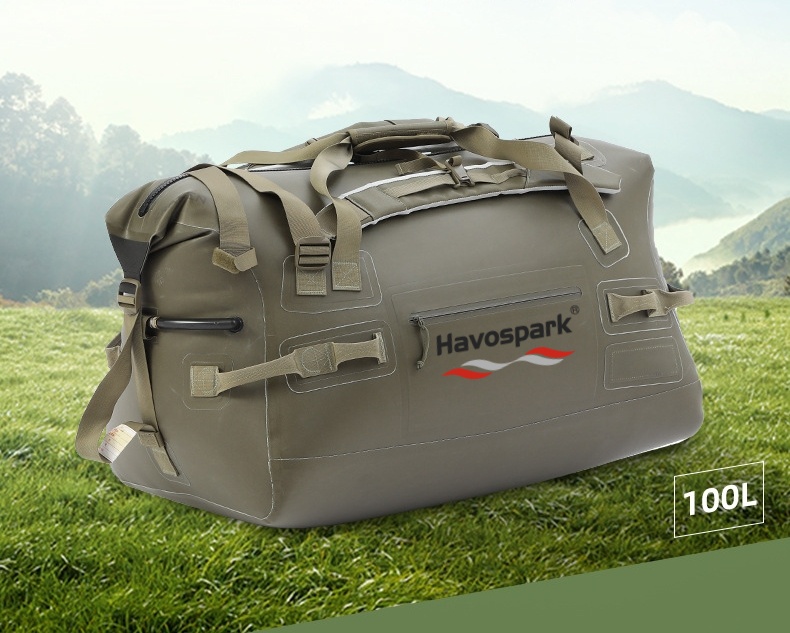
Material Durability: PVC, TPU, and Coated Nylon for Demanding Water Sports
Tensile Strength and Abrasion Resistance by Material Type
A waterproof bag’s ability to withstand scrapes against rocks, sand, and equipment begins with tensile strength and abrasion resistance. PVC fabric—valued for its cost-effectiveness—offers moderate puncture resistance, sufficient for casual paddling but prone to tearing under sharp, concentrated loads. TPU (thermoplastic polyurethane), by contrast, delivers superior toughness thanks to its elasticity: it absorbs impacts and resists crack propagation even in cold or high-flex conditions. Industry testing consistently shows TPU outperforming PVC in both tear strength and elongation at break—key reasons it’s the standard for whitewater rafting and rescue gear.
Coated nylon merges nylon’s high-tensile base with a waterproof barrier, typically a TPU film. While the underlying fabric resists stretching and ripping, long-term abrasion resistance hinges entirely on coating integrity. Once the TPU layer wears thin, exposed nylon absorbs water and frays rapidly. In Taber abrasion testing, 500D PVC failed after ~800 cycles, while 420D TPU exceeded 1,500 cycles—nearly doubling surface durability under continuous scuff conditions.
UV and Saltwater Degradation: Real-World Lifespan Data (500D PVC vs. 420D TPU)
Intense UV exposure and salt spray accelerate material degradation. A 2023 accelerated weathering study simulating 12 months in tropical marine conditions found 500D PVC lost 35% of its original tensile strength, with visible stiffening, color fading, and micro-cracking driven by plasticizer migration—a known weakness of PVC under UV.
420D TPU retained 82% of its tensile strength under identical conditions. Aliphatic TPU grades, formulated with UV stabilizers, resisted yellowing and surface chalking, while inherent hydrolysis resistance prevented softening in saltwater. Nylon fabrics coated with TPU performed intermediately: the coating provided strong initial UV shielding, but once compromised, the nylon core degraded rapidly. Field repair logs from surf zones and deck-stored gear show 420D TPU bags develop one-third the rate of seam-adjacent pinholes compared to equivalently used 500D PVC models—confirming its durability advantage in harsh marine environments.
Seam Construction: Why RF-Welded Seams Are Essential for True Waterproof Integrity
Hydrostatic Head Test Results: How Seam Method Impacts 10,000mm+ Pressure Resistance
RF (Radio Frequency) welding fuses thermoplastic panels at the molecular level—eliminating stitch holes, the primary leak path in sewn waterproof bags. In hydrostatic head testing—where water pressure rises until failure—RF-welded seams consistently exceed 10,000 mm of water column resistance, the benchmark for prolonged submersion. Taped seams rely on adhesive applied over needle holes; under dynamic load, that tape peels at pressures as low as 5,000–7,000 mm. Controlled lab tests recorded an average taped-seam failure at 6,200 mm, while RF-welded seams showed zero ingress at 10,000 mm. Because the weld is as strong as the base material, no weak interface exists for water to exploit—making RF welding non-negotiable for kayakers, canyoneers, and anyone subjecting gear to full immersion.
Field Failure Rates in Rafting & SUP: Industry Repair Logs Show 3.2× More Seam Leaks in Taped vs. RF-Welded Waterproof Bags
Real-world use magnifies the gap. A 2024 analysis of repair logs from multiple outdoor gear service centers found taped-seam bags developed seam leaks at 3.2× the rate of RF-welded counterparts. Adhesive breakdown under UV, saltwater, and repeated folding drove 68% of taped-seam failures within the first 12 months of frequent rafting or SUP use. RF-welded seams—permanent molecular bonds—maintained watertight integrity for over three years on average under identical high-stress conditions. Crucially, taped-seam failures often cascaded into panel separation, while RF-welded bags rarely failed at the seam. For athletes who depend on dry gear for safety and performance, field data confirms RF welding delivers unmatched long-term seam reliability.
Closure Systems: Matching Roll-Tops, Waterproof Zippers, and Press-and-Seal to Your Water Sport
The closure is the final line of defense—and the most common point of failure—in waterproof bags. For water sports where gear faces splashes, spray, and brief submersion, seal integrity directly determines whether contents stay dry. Roll-top, waterproof zipper, and press-and-seal systems each serve distinct roles, with clear trade-offs under real-world stress.
Roll-Top Performance in Turbulent Conditions: Buoyancy Retention and Submersion Recovery Time
A roll-top closure folds the bag opening three or four times before securing with buckles, creating an air-tight chamber that traps buoyant air. In whitewater or rough surf, this trapped air keeps the bag afloat and enables near-instantaneous surface recovery after submersion. Independent testing shows a correctly sealed roll-top bag retains enough buoyancy to remain on the surface for over 30 minutes—even after repeated dunking. Its multi-fold barrier resists forced water entry during turbulence, and recovery time is negligible: once surfaced, contents stay dry and the pack remains ready for immediate use.
Waterproof Zippers (YKK Aquaseal®) vs. Ziplock Seals: Leakage Thresholds Under Dynamic Load
Waterproof zippers—such as YKK Aquaseal®—use rubberized tracks and sealing lips to block moisture but remain vulnerable when flexed or compressed. Under dynamic load (e.g., kayak rolls or hard tosses), they typically begin weeping at around 2 psi. Ziplock-style press-and-seal closures—common in light-duty bags—leak at pressures as low as 0.5 psi when twisted or squeezed. For activities involving tossing, sitting on, or pulling the bag through water, ziplock seals are fundamentally unreliable. Waterproof zippers offer convenient quick access, but for primary compartments in submersion-grade gear, they should never replace a roll-top.
Water Sports–Specific Design Features: Buoyancy, Visibility, and Load Distribution
A well-designed waterproof bag does more than keep contents dry—it solves on-water challenges. Built-in buoyancy—achieved via closed-cell foam inserts or air-trapping roll-top closures—keeps the bag afloat even when fully loaded. High-visibility colors like neon orange or fluorescent yellow, paired with reflective webbing, significantly reduce loss risk in surf, whitewater, or low-light conditions. Equally critical is intelligent load distribution: wide, padded shoulder straps and adjustable sternum or waist belts prevent shifting during paddling, while multiple reinforced attachment points allow secure mounting to kayak decks or SUP bungee systems. These features transform a simple dry sack into a purpose-built, human-centered tool for aquatic performance and safety.
FAQ
What makes TPU more durable than PVC in waterproof bags?
TPU is more elastic than PVC, allowing it to absorb impacts and resist cracking under stress. It also has higher tear strength and superior performance against UV degradation and saltwater exposure, making it ideal for demanding water sports.
Why are RF-welded seams better than taped seams?
RF-welded seams fuse materials at a molecular level, eliminating stitch holes and weak points. They maintain their integrity under high pressure and dynamic conditions, while taped seams often fail due to peeling, especially when exposed to UV light and repeated stress.
What closure systems work best for full submersion?
Roll-top closures provide the best protection under full submersion. They create an airtight, multi-fold barrier that resists forced water entry and retains buoyancy, unlike waterproof zippers or ziplock seals, which are less reliable under dynamic load or high pressure.
How do high-visibility waterproof bags enhance safety?
High-visibility colors like neon orange and fluorescent yellow, combined with reflective webbing, make it easier to locate bags in surf, whitewater, or low-light conditions, reducing the risk of loss during water sports activities.
Table of Contents
- Material Durability: PVC, TPU, and Coated Nylon for Demanding Water Sports
- Seam Construction: Why RF-Welded Seams Are Essential for True Waterproof Integrity
- Closure Systems: Matching Roll-Tops, Waterproof Zippers, and Press-and-Seal to Your Water Sport
- Water Sports–Specific Design Features: Buoyancy, Visibility, and Load Distribution
- FAQ